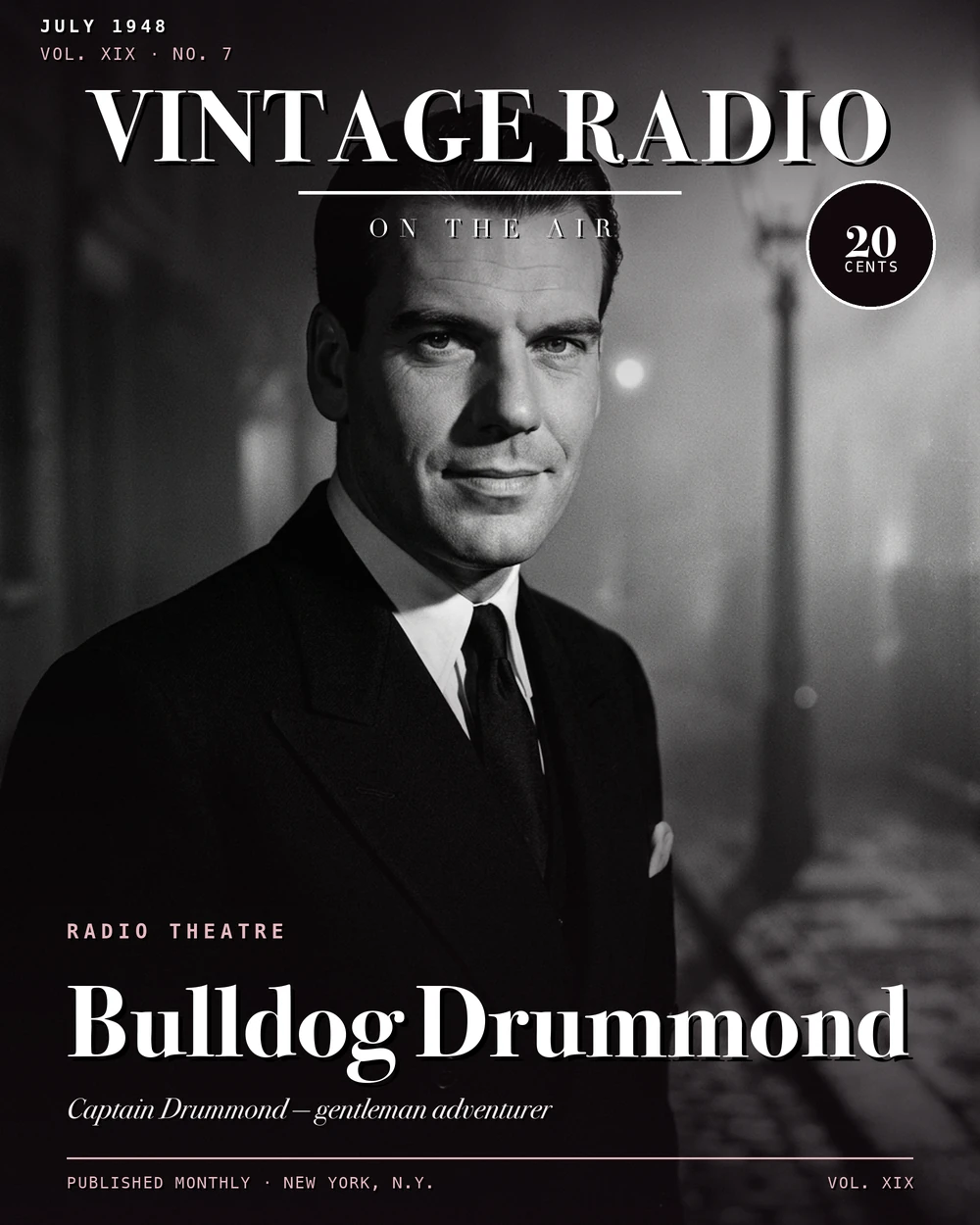
Bulldog Drummond
The Fog, the Footsteps, and the Pitch
If you grew up listening to Mutual in the 1940s, the opening of Bulldog Drummond probably stuck with you long after you forgot the plots. Hollow footsteps. A foghorn somewhere in the distance. Two sharp gunshots. Then three blasts of a policeman's whistle — and a voice steering the listener across the Atlantic: out of the fog, out of the night, and into his American adventures. Producer-director Himan Brown designed that signature himself, layering the sounds to conjure a London atmosphere before the show had even gotten started. It worked well enough that listeners remembered it for decades, and scholar Garyn G. Roberts, writing in Dick Tracy and American Culture, called it one of the "premiere mystery programs of its time" partly on the strength of that foghorn alone.
The show was based on the novels of H. C. McNeile — better known by his pen name "Sapper," the army slang for a Royal Engineers soldier. McNeile, a colonel in the Royal Engineers during World War I and a recipient of the Military Cross, had been required by military regulations to publish under a pseudonym, so "Sapper" he became. His first Bulldog Drummond novel appeared in 1920, introducing the character as a bored post-war adventurer who places a newspaper advertisement seeking excitement. McNeile wrote ten novels, four short story collections, and four stage plays before his death in 1937, all through Hodder & Stoughton. His friend Gerard Fairlie then carried the series forward, publishing new Drummond novels from 1938 through 1954 — the same year the radio show aired its final episode. McNeile had also modeled the character partly on Fairlie himself, and partly on his own ideal of an English gentleman.
By the time radio picked the character up, Drummond was already well-known from the Paramount detective films of the 1930s, where Ronald Colman, John Barrymore, John Howard, Ray Milland, and Ralph Richardson had each taken a turn in the role. Ian Fleming later acknowledged Drummond's influence on the creation of James Bond.
How It Got on the Air
The Mutual series premiered on April 13, 1941, originating at WOR in New York City and distributed nationally by the Mutual Broadcasting System, with Canadian carriage as well. It debuted as a summer replacement for Show of the Week, airing Sundays at 6:30. For the first two months, the show stayed in its source material's natural habitat, setting Drummond's cases in Britain. Then the pivot: the line about "American adventures" became literal, and the show shifted its setting to the United States for the rest of its run. The alternate title sometimes used in listings — The American Adventures of Bulldog Drummond — reflected that change plainly enough.
The radio version made several notable departures from McNeile's novels. Drummond's wife disappeared entirely. So did his circle of ex-army comrades, who had populated the books as a kind of amateur action squad. What remained was Drummond and his butler Denny, who served as the show's regular sidekick throughout the run. The cases ranged well beyond straightforward murder — espionage, international intrigue, kidnapping, wartime sabotage, and, in later years, plots with atomic-age dimensions all appeared in the episode mix. A September 1943 episode, sponsored by Horton's Ice Cream, sent Drummond to investigate a murder on the piers and ended with two Nazi submarines sunk. That episode, originating from WOR New York, gives a good sense of where the show's energy was directed during the war years.
The schedule shifted frequently — across the Mutual run the show bounced through Sunday evenings, Monday evenings, Friday nights, and Wednesday nights before the first run ended on January 12, 1949. In 1948, distribution shifted from Mutual's network feed to syndication via electrical transcription, handled by the Chartoc-Coleman company, with a separate Ziv deal running on another track. On the West Coast, ABC carried 53 episodes beginning in May 1948 and ending May 27, 1949. A trade advertisement from the period boasted: "Year after year, since 1941, Drummond has rung up top ratings." Media critic John Crosby, writing in the Oakland Tribune in 1948, called it "the first of the more successful exemplars of radio espionage and intrigue."
Himan Brown and the Production
Himan Brown, born in Brooklyn in 1910 and trained as a lawyer at Brooklyn Law School — where he graduated as class valedictorian — turned out to have a sharper eye for radio rights than for courtrooms. He used his law degree to acquire the broadcast rights to a string of popular fictional characters: Dick Tracy, Flash Gordon, the Thin Man, and Bulldog Drummond among them. Over a career spanning more than 65 years, Brown produced more than 30,000 radio programs across all the major networks and syndication. He was inducted into the National Radio Hall of Fame in 1990 and later received a Peabody Award for CBS Radio Mystery Theater. He died in 2010, just weeks before his 100th birthday.
For Bulldog Drummond, Brown served as both producer and director throughout the run, with the RadioGold Index confirming his dual role on surviving 1943 and 1948 episodes. The writing staff included Allan E. Sloane and Leonard Leslie. Sound effects — critical to a show whose identity was rooted in its opening signature — were handled at various points by Adrian Penner, Walt Gustafson, and Walt Shaver. Organist Lew White provided music on at least some episodes. Announcers across the run included Ted Brown, Henry Morgan, Robert Shepard, and Jackson Beck, who also doubled as a performer in at least one episode.
Brown had earlier recruited his Brooklyn College classmate Irwin Shaw to write scripts for his early radio work, giving Shaw his first paid writing job. Shaw later put a character based on Brown into his 1951 novel about the radio industry, The Troubled Air.
The Cast Across the Years
George Coulouris played Bulldog Drummond when the show launched in 1941. Born in Manchester to an English mother and a Greek immigrant father, Coulouris was a charter member of Orson Welles's Mercury Theatre, where he had played Mark Antony in the company's 1937 debut production — a modern-dress staging of Julius Caesar. In the same year he started on Bulldog Drummond, he appeared as Walter Parks Thatcher in Welles's Citizen Kane, for which he won a National Board of Review Best Actor award. The RadioGold Index documents 55 radio programs Coulouris performed in the United States before 1949.
The early show drew more broadly from the Mercury Theatre company: Agnes Moorehead, Paul Stewart, and Ray Collins all appeared as supporting players in the first years, with Mercedes McCambridge a regular presence as well. Everett Sloane, another Mercury alumnus, played Denny, Drummond's sidekick, from 1941 to 1942. After 1942, the lead passed to Santos Ortega and Ned Wever, both radio veterans — Ortega from Dick Tracy and Perry Mason, Wever from The Shadow. Luis Van Rooten took over Denny in the mid-1940s, with Rod Hendrickson also stepping into the role at some point.
The 1954 revival brought in the most distinguished lead the show ever had: Sir Cedric Hardwicke, the celebrated English stage and film actor who had been knighted in January 1934 at the age of 41 for his interpretations of George Bernard Shaw — and whom Shaw himself had described as his fifth favourite actor, after the four Marx Brothers. Hardwicke had trained at the Royal Academy of Dramatic Art, made his stage debut in 1912, and built a career that ranged from Les Misérables (1935) to The Hunchback of Notre Dame (1939) to Alfred Hitchcock's Rope (1948) to Cecil B. DeMille's The Ten Commandments (1956), in which he played the Pharaoh Sethi. He published two volumes of memoirs during his lifetime, and died in New York City on August 6, 1964.
The revival itself was packaged as part of Mutual's new "star-name" programming initiative, promoted alongside Counterspy and Starlight Theatre as one of 18 new star-name shows. Dodge Motors sponsored it, and it aired Sundays at 6:00 from January 3 to March 28, 1954.
What the Show Was and Wasn't
The honest assessment, for all the atmosphere Brown built into it, is that Bulldog Drummond was a B-grade detective property on both screen and radio — a show with strong ambience and recurring villains drawn from the underworld, counterfeiting rings, and the usual array of killers, but not a program that broke new ground in storytelling. What it did have was consistency, a memorable sound, and a character who carried enough accumulated pop-culture weight from the novels and films to keep audiences coming back.
Relatively few episodes from the Mutual run have survived. The cases that do remain document the range the show attempted — "Death Loops the Loop," "Murder Has an Open Mind," "Death Under the Big Top," "The Island of Death" — titles that tell you exactly what kind of program this was. Whether that's a limitation or part of the appeal depends on the listener. For those who remember the hollow footsteps and the foghorn, it was apparently enough.